
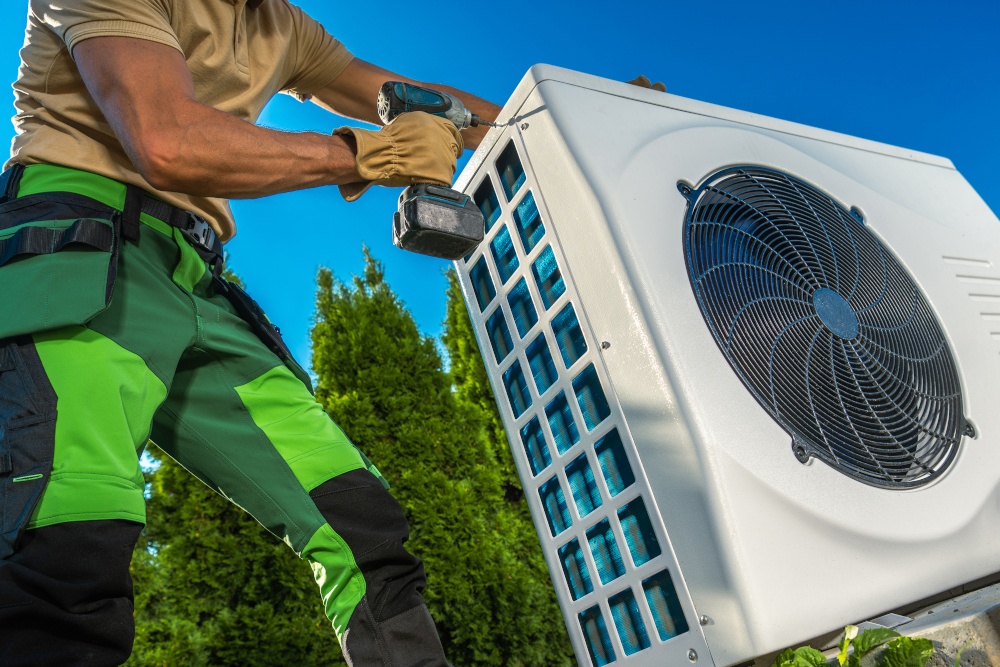
The rising costs of gas and electric heating, as well as the use of pellet boilers, mean that more and more people are seeking solutions that minimize the costs of central heating systems. One of the increasingly popular options is eco-friendly heat pumps . What are the advantages of a heat pump? Is heating with heat pumps affordable? Are heat pumps cost-effective? You'll find the answers to these questions in our article.
Does it make sense to install a heat pump?
Heat pumps of all types, including air-to-water and ground-source heat pumps, are ideal for heating and domestic hot water systems. Air-to-air heat pumps are recommended for space heating only. These systems are suitable for single-family homes, for example, where there is a significant demand for electricity for heating and domestic hot water.
The undoubted advantage of heat pumps is the possibility of using them in new and already used houses. Heat pump systems can be connected to both existing and new heating installations. Air pumps work well in heated systems such as surface heating, including underfloor heating, and even in systems based on traditional radiators. Heat pump systems also have the advantage of taking up little space. They do not need a special room to house the boiler, i.e. a boiler room, or a place to store fuel, as is the case with heating using solid and liquid fuels (e.g. oil, coal, pellets or gas). Good heat pumps can operate without failure for up to 20-30 years, which makes them an excellent investment for many years.
Moreover, heat pumps are perfect in places where it is not possible to connect another heat source. They do not require creating a complicated installation, as is the case with other heating systems.
It is worth adding that heat pump systems guarantee zero greenhouse gas emissions. They also do not emit toxic substances resulting from combustion, so not only do you contribute to the protection of the natural environment, but you can also enjoy clean air around your home.
What benefits does a heat pump provide to users?
Heat pumps are an extremely convenient system that is basically maintenance-free. Your only role is to set the set temperature you want to obtain in the rooms or on the hot water boiler in order to enjoy hot water in the tap and the optimal temperature in the building adapted to your needs. Moreover, in the case of good systems, you can set the temperature not only manually, but also using a remote control or even an application installed on a mobile device (e.g. smartphone, tablet or laptop).
It is worth emphasizing that most air heat pumps have a reversible function. This means that they can be used for heating in winter and cooling in summer. This makes them devices that you can use all year round.
An undeniable advantage of heat pumps, especially those using solar electricity (photovoltaic panels), is their extremely low operating costs. So, when asking whether a heat pump is worth installing, in the vast majority of cases, the answer is absolutely yes! If you've been using traditional electric heating, a heat pump can reduce operating costs, and consequently, electricity consumption, by up to 60-70% annually. If you also power your heat pump system with electricity from PV panels, heating can be even more affordable.
It is worth emphasizing that good heat pump models are characterized by high reliability and low failure rate. This means that such a system can operate fully efficiently for 20-30 years without the need for additional financial outlays for repairs.
It cannot be denied that installing a heat pump in a building significantly increases the value of the entire property. Such facilities are sought after on the market due to the high energy efficiency of the building and comfort of use. Importantly, facilities equipped with heat pump heating are extremely safe. They are not at risk of fire or explosion caused by heat source failure.
Is it worth installing a heat pump without photovoltaics?
A proven and extremely economically and energy-efficient solution is the use of a heat pump heating system in a facility with photovoltaic panels. Contrary to appearances, photovoltaics also work well in generating electricity in autumn, spring and winter. As a result, it can supply electricity to systems in your home that are powered by electricity year-round.
Combining photovoltaics with a heat pump is the most profitable and provides many benefits for users. Investing in a heat pump and photovoltaic panels ensures greater energy independence. At the same time, it minimizes the impact of electricity increases on your bills. This is due to the fact that most of the energy needed to power the heat pump comes from renewable energy sources, so the electricity obtained is free.
Moreover, the use of a heat pump in combination with a PV system allows for efficient use of surplus electricity. Contrary to appearances, this is important, especially on sunny days, when installations are sometimes disconnected from the energy system due to the inability to absorb excess energy. Using a heat pump in combination with photovoltaics also translates into environmental protection - by using renewable energy sources, you minimize greenhouse gas emissions into the atmosphere. When investing in a combination of a heat pump with photovoltaics, it is worth being aware that it will be crucial to select the appropriate parameters of both the PV panels and the heat pump system.
Is it worth installing a heat pump without photovoltaics? Of course, but you must take into account that investing in a heat pump will be less profitable and the payback time will be significantly longer.
What is the cost of installing a heat pump?
How much does a heat pump, including installation, cost? It's a significant investment—a good-quality model costs around 40 PLN. However, it's worth knowing that heat pump installation can be subsidized by government programs and allows for a tax deduction for the investment costs under thermal modernization tax relief. In the most favorable scenario, installing a heat pump can cost just tens of thousands of zlotys. We're talking about the costs associated with installing a heat pump. Once the system is operational, you can start enjoying lower monthly electricity bills. This means a heat pump quickly pays for itself. If you combine it with photovoltaics, the heat pump cost will be recouped in just 7-8 years.
Is a heat pump worth it? Of course, the overall cost of a heat pump depends on the brand, the complexity of the system, and its connection to a PV system. However, the benefits of such a heating system, both short-term and long-term, cannot be overstated.
When is it not profitable to install a heat pump?
Air-source heat pumps generally offer a return on investment within 5-7 years of installation. However, there are several factors that can significantly prolong the payback period or render the investment unprofitable.
Heat pumps must be installed in buildings with high thermal insulation parameters. Buildings that are uninsulated or have insufficient insulation, thermal bridges, leaky windows, etc. will generate much higher costs of using heating based on an air heat pump. As a result, it may turn out that the investment in a heat pump not only does not pay off, but also generates high maintenance costs due to high electricity consumption. In such a situation, it is worth insulating the building appropriately to prevent heat from escaping from the building.
Another reason for the lower profitability of air-air or air-water heat pumps is very low outdoor air temperatures - e.g. -20 degrees C. In such a situation, the air heat pump will need much more electricity to operate properly and heat the facility. Therefore, if you live in a place where winter temperatures regularly drop to 20 degrees or more below zero, consider other solutions for heating the building. One of them is the use of a ground heat exchanger, which is much less susceptible to changes in external temperature.